
Cirugía de Abdomen en Los Ángeles
Bienvenido a la prestigiosa clínica de cirugía estética del Dr. Sean Satey, donde nos especializamos en la abdominoplastia, también conocida como tummy tuck. Con una meticulosa atención al detalle y un compromiso con resultados naturales, nuestro equipo experto redefine los contornos abdominales para ayudarte a lograr la apariencia firme y estilizada que deseas.
Agenda una consulta
¿Qué es una Abdominoplastia o Tummy Tuck?
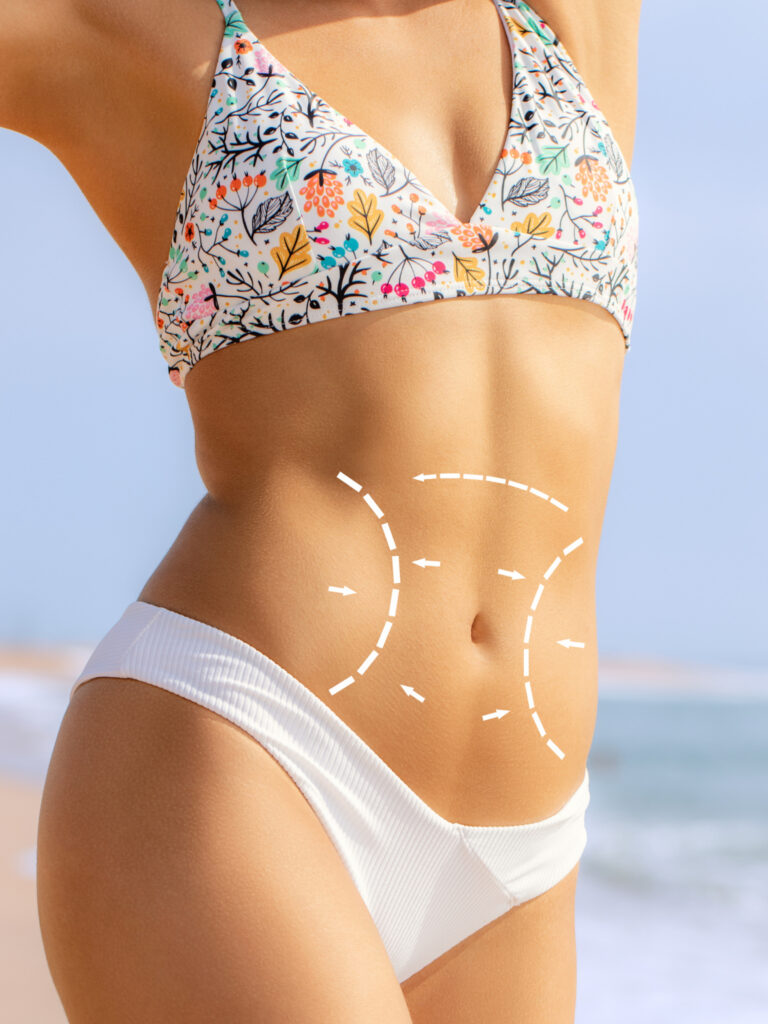
Una abdominoplastia, comúnmente conocida como tummy tuck, es un procedimiento quirúrgico diseñado para eliminar el exceso de piel y grasa del abdomen, mientras se tensan los músculos abdominales.
Este procedimiento es ideal para personas que han experimentado:
✔ Pérdida de peso significativa y tienen piel flácida.
✔ Embarazos que han dejado el abdomen con exceso de piel o músculos debilitados.
✔ Acumulación de grasa abdominal resistente a dieta y ejercicio.
El resultado es un abdomen más plano, firme y tonificado, ayudando a mejorar la apariencia y confianza del paciente.
Opciones Quirúrgica
La mejor opción dependerá del grado de debilidad muscular en la línea media (diástasis de los rectos) y de la ubicación del exceso de piel (abdomen superior, inferior o ambos). Ya hablamos sobre la diástasis de los rectos en otro video, ¡así que no olvides verlo!
🔹 Abdominoplastia tradicional: Si tienes una diástasis recti significativa o exceso de piel tanto en el abdomen superior como inferior, eres un excelente candidato para una abdominoplastia tradicional. Este procedimiento:
✔ Corrige la debilidad muscular en la línea media.
✔ Elimina el exceso de piel para un abdomen más firme.
✔ Crea un nuevo ombligo natural y estético.
🔹 Mini abdominoplastia: Si solo tienes piel suelta entre la parte baja del ombligo y la región púbica, la mejor opción es una mini abdominoplastia. En este procedimiento:
✔ Se remueve el exceso de piel del abdomen inferior.
✔ Se logra un abdomen más liso y tonificado con una incisión más pequeña.
Ya hablamos sobre las incisiones en otro video, ¡así que no olvides revisarlo también! 😊
El término "Mini" puede ser un poco engañoso
Aunque el nombre mini abdominoplastia sugiere un procedimiento más pequeño, la realidad es que la longitud de la incisión suele ser similar a la de una abdominoplastia completa. Sin embargo, esto puede variar según el paciente.
📌 ¿Cuál es la diferencia principal?
✔ Una abdominoplastia completa corrige la debilidad de los músculos abdominales en la línea media (diástasis de los rectos abdominales).
✔ Además, en una abdominoplastia completa, se reconstruye el ombligo para lograr una apariencia más estética.
✔ En cambio, una mini abdominoplastia no implica la creación de un nuevo ombligo ni la reparación de los músculos.
📌 ¿Cuál es la mejor opción para ti?
Si bien la recuperación de una mini abdominoplastia es más rápida, lo más importante es determinar qué procedimiento se adapta mejor a tu caso específico.
🔹 Durante tu consulta, asegúrate de discutir la longitud de la incisión y si necesitas una reparación muscular (plicatura de los músculos rectos del abdomen).
👨⚕️ El Dr. Sean Satey te ayudará a elegir la mejor opción para lograr el abdomen firme y tonificado que deseas.
¿Cómo es el proceso de una abdominoplastia in Los Angeles?
📌 Preparación antes de la cirugía
✔ Se desinfecta todo el cuerpo con una solución antiséptica para minimizar el riesgo de infección y eliminar bacterias en la piel.
✔ Algunas de las soluciones más utilizadas incluyen Betadine y Clorhexidina.
✔ Se colocan dispositivos de monitoreo de seguridad, y el anestesiólogo administra los medicamentos para inducir el sueño.
✔ ¡Luego, comienza la cirugía planificada!
📌 Recuperación postoperatoria
Antes de tu cirugía, habremos decidido si necesitarás una clínica de recuperación postoperatoria.
🔹 Estas instalaciones cuentan con enfermeras especializadas que monitorean tu estado de salud, te mantienen cómoda y facilitan tu transición segura a casa.
🔹 La estancia suele ser de 24 horas o la noche de la cirugía.
📌 Cuidados tras la cirugía
🏠 Caminar es clave para la recuperación. A pesar de la incomodidad inicial, recomiendo levantarme y caminar lentamente el mismo día de la cirugía para reducir el riesgo de coágulos sanguíneos.
💧 Drenajes quirúrgicos
✔ Todos mis pacientes de abdominoplastia tendrán dos drenajes para evitar acumulación de líquido y prevenir seromas.
✔ Los drenajes suelen permanecer entre 7 y 14 días.
🔹 Nuestro equipo estará contigo en cada paso del proceso para garantizar una recuperación segura y exitosa.
Tiempo de recuperación: ¿Qué esperar?
⏳ La recuperación varía de un paciente a otro, pero aquí tienes una guía general:
✔ 2 semanas – La mayoría de los pacientes pueden regresar al trabajo (sin levantar peso ni hacer esfuerzos intensos). 📌 ¡Recuerda! En este punto, también se retiran los drenajes.
✔ 6 semanas – Casi sin restricciones, ya que el 80% de la cicatrización está completa. 💪
✔ 3 meses – Gran parte de la inflamación ha bajado y los resultados comienzan a notarse. 🔥
✔ 6 meses – Tu cuerpo ha sanado en un 90% y la piel se sigue asentando.
✔ 1 año – ¡Tu nuevo cuerpo ha tomado forma! Este es tu resultado final y tu nueva base. 🎉
😊 Recuerda que cada paciente es diferente, pero nuestro equipo estará contigo en cada paso del proceso.
Will i need an incision?
One of my most frequently asked questions is, “Do I need an incision?”
I wish the answer was simple!
It all depends on 4 key factors:
- Adiposity (or, fat) amount and its location
- Skin redundancy and laxity
- Age: younger versus older patient
- Previous procedures: previous liposculpting, coolsculpting, botched surgery, etc
Patients with increased adiposity, skin redundancy and laxity, older age, and history of previous procedures are at higher likelihood of incision need.
What are drains?
A drain is just a tool that helps collect fluid!
Whether you’re having a tummy tuck or liposculpting, there is always the creation of a “potential space.” For example, when I liposuction the fat, it creates a an “empty” or “potential space.” Now, our bodies are smart- they try to fill the space the best way they know how to- with fluid. That’s where the drains come in and drain that fluid.
The removal process depends on several factors- color, character, quantity.
Initially, the effluent color is reddish. It’s often times confused with blood in the early post op period. However, it’s not- it’s a thin fluid (unlike blood), that looks more like Kool-Aid; this is called serosanguinous drainage. As time goes on, this color changes to more of a straw or apple juice color, and is called serous drainage. The goal is to have less than 30cc of thin, serous drainage in a 24 hour period prior to removal.
My primary goal is to help you have an easy post-operative recovery, and to become the best version of you!
How do we address the skin?
In a different video, we went over how my liposculpting is different- the use of VASER assistance!
We left off on the two pathways that emerge after liposculpting is complete (in addressing the skin): skin removal via excision versus skin tightening using Renuvion J-Plasma or BodyTite.
The determining factor of whether you’re a candidate for an incision versus tightening is the degree of skin redundancy and laxity that you have at the start of the procedure.
For example, if you have a significant amount of loose skin and fat at the level of your belly button and below (also known as a pannus), liposuctioning the fatty tissue will result in additional loose skin, and hang. In that circumstance, you would be a great candidate for an incision to address the skin redundancy.
How long the incision will be and where the incision will be placed are both covered in different videos!
Now, if you don’t have a lot of loose skin at the start of the procedure, and we encounter skin laxity intra-operatively as a consequence of liposuctioning, you’re a great candidate for skin tightening – either through the use of Renuvion J Plasma or BodyTite.
This minimally invasive technique is performed through the same small poke holes used for the liposuctioning procedure, and will give you about 30-50% skin tightening!
Mommy makeover
What’s a Mommy Makeover?
It’s a surgery that involves both an abdominal and breast procedure!
For the abdominal portion- this includes a mini tummy tuck, full tummy tuck (most common), or a pubic skin excision.
For the breast portion- this includes a breast augmentation (saline, silicone, or fat transfer) or breast lift (with or without an augmentation).
At the time of your consultation, we can assess your goals and determine your candidacy!
Pregnancy and abdominoplasty
The best time to get a tummy tuck is after you are done having children. The reason is because a tummy tuck involves the plication (or tightening) of your midline muscles- and it’s best to have that done after bearing children.
Can you have children after having a tummy tuck procedure?
Absolutely.
However, pregnancy may result in repeat weakening of your abdominal musculature, and additional loose skin.
If you’re planning to have a child after a tummy tuck procedure, be sure to let your surgeon know. I usually tell my patients to wait a year following surgery, if they can.
Daddy makeover
The first thing that needs to be addressed is – where’s the problem area?
Your abdominal fat can be broadly categorized into two categories:
ABOVE and BELOW the abdominal muscles.
The fat that is below your abdominal rectus muscles is termed, visceral fat. That’s the fat that surrounds your organ systems. Unfortunately, that fat, or adiposity, CANNOT be addressed with liposculpting. Instead, diet, exercise and bio-identical hormone therapy are the only methods that can address the visceral adiposity.
Now, if your abdominal adiposity is located above the abdominal rectus muscles, this is termed as subcutaneous fat- or simply put, fat under the skin (and above the muscles). This fat CAN be subjected to liposculpting and/or excision!
If you have a midline abdominal muscle weakness (known as a diastasis recti), you may be a candidate for a full tummy tuck (traditional abdominoplasty) procedure.
If not, and depending on your BMI (body mass index), you may be a great candidate for abdominal etching with VASER assisted liposuction and J Plasma skin tightening to showcase your muscles!
How long will my incision be?
The short answer is- as long as it needs to be to give you the absolute best result!
The goal is always to make the smallest surgical incision, in a place that can be well hidden. At the end of the day, we want things to be as natural as possible.
The best way to determine your incision length, and location, is to have a thorough physical examination by your surgeon.
I always try to give my patients a visual representation of their planned incision length on their body during their consultation.
Proper incision placement
For once, the answer is simple:
One that is well hidden!
For example, if you’re undergoing a tummy tuck, I want your incision placed within your bikini or boxer line. If you’re undergoing liposuction- I want your incisions in natural skin folds or creases. If you need drains- they should be placed in areas that will ultimately be hidden.
The key is to make you look at as natural as possible. One thing that I often do for my patients is show them where their planned incisions will be during their consultation. When you see your surgeon, make sure to ask them to map the incisions out for you!
Diastasis recti
It’s a separation of the large midline abdominal muscles!
This commonly happens after pregnancy, or significant weight gain/loss.
As the abdomen stretches to accompany a baby or excessive intra-abdominal (visceral) fat, the muscles stretch thin, and weaken at the midline. Once the baby is delivered or excessive weight is lost, the muscles continue to have an inherent laxity/weakness, or central bulging.
To test whether or not you have a component of a diastasis recti, stand in front of a mirror. Now, let your belly out by relaxing the muscles. Then, suck in as hard as you can.
Do you see a significant difference?
If the answer is yes, you may have a diastasis recti.
I fix this during my signature high definition tummy tucks (abdominoplasties)- it’s permanent and helps “snatch” (pull in) the waist line. You’re new baseline will be similar to you always sucking in your belly!
At the time of your consultation, we can assess your goals and determine whether or not you have a diastasis recti!
What is an innie belly button?
Before we get into that- let’s take a step back.
What’s the telltale sign that someone has had a tummy tuck?
The belly button!
It’s an area that’s really hard to cover up if you’re wearing a two piece bikini or swimming trunks!
The key to a beautiful belly button is to make sure that’s it’s natural: an innie, proportional to your body, centered, and beautiful shape.
This is also the time where you want to be evaluated for an “umbilical hernia” (aka, belly button hernia). Should you have one, this would be the time to repair it!
Why are drainless tummy tucks not recommended?
Recently, there has been a lot of buzz over drainless tummy tucks.
However, I do not recommend them!
With a tummy tuck procedure, there is significant undermining (separation) of the abdominal tissues (skin and fat) from the underlying muscles (rectus muscles). This is done so that the midline muscle weakness (diastasis recti) can be repaired.
During the immediate recovery period, your body tries to fill this potential space space with fluid, since it’s hasn’t reattached yet.
The purpose of the drains are to remove and collect this fluid!
Now, if there is no drain, what happens is that the fluid will build up and need to be drained. The drainage procedure is the insertion of a needle attached to a syringe and fluid is aspirated, on several occasions. There is also an increased risk of infection with each aspiration, capsule formation, and possibility of irregularities to the skin when healing is complete.
My recommendation is to not cut corners if you need a tummy tuck, and to get it done in a safe and effective way- with drains! I’m here to help you become the best version of you!
What are drains?
A drain is just a tool that helps collect fluid!
Whether you’re having a tummy tuck or undergoing liposculpting, there is always the creation of a “potential space.” For example, when I liposuction the fat, it creates an “empty” or “potential space.” Now, our bodies are smart- they try to fill the space the best way they know how to- with fluid. That’s where the drains come in and drain that fluid.
The removal process depends on several factors- color, character, quantity.
Initially, the effluent color is reddish. It’s often times confused with blood in the early post op period. However, it’s not- it’s a thin fluid (unlike blood), that looks more like Kool-Aid; this is called serosanguinous drainage. As time goes on, this color changes to more of a straw or apple juice color, and is called serous drainage. The goal is to have less than 30cc of thin, serous drainage in a 24 hour period prior to removal.
My primary goal is to help youhave an easy post-operative recovery, and to become the best version of you!